



Two pink lines appeared almost immediately.
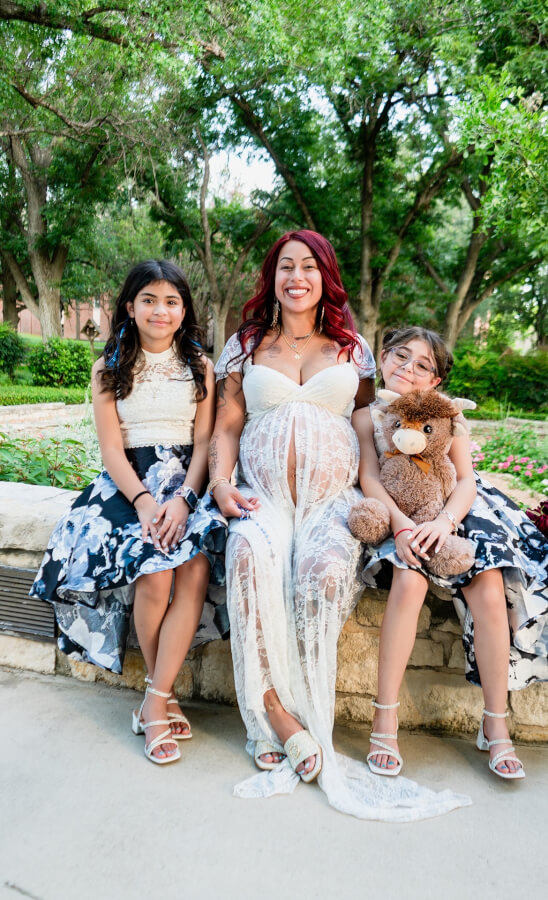
The home pregnancy test brought forth a future that Deziree Ibarra once thought lung cancer had taken away from her. For nearly five years, she took a medication that targeted her tumors and kept the cancer under control, while a life that included motherhood seemed increasingly out of reach.
“Is this my gift? Is this my blessing that I never thought was coming?” She remembered thinking once her pregnancy was confirmed.
The trouble was that her medication had not been formally studied in pregnant patients. Stopping it could allow the cancer to worsen; continuing it could expose her developing baby to unknown risks.
Specialists at UT Health San Antonio’s Mays Cancer Center and maternal-fetal medicine specialists at UT Health San Antonio worked with Ibarra to adjust her cancer treatment as her pregnancy evolved.
A treatment matched to her cancer
Ibarra was 30 years old, working as a hairstylist, taking college courses and helping raise her two nieces when persistent shortness of breath led to the discovery of a mass in her left lung in the fall of 2020. A biopsy later confirmed stage 4 non-small cell lung cancer. Molecular testing then found an ALK gene mutation within her cancer cells.

Abhishek Pandya, DO, Ibarra’s oncologist at the Mays Cancer Center, explained that this type of lung cancer can occur in younger patients, particularly women, who have never smoked. The ALK mutation is generally not inherited.
“The mutation happens within your own cancer cells in your lifetime, not something you were born with,” Pandya said.
“I definitely felt like my world had flipped,” Ibarra said. “The unknowing of the future was scary.”
However, finding the gene alteration gave her physicians a specific target. Ibarra began taking alectinib, an oral therapy designed for cancers with the ALK mutation. Her lung tumor shrank, the fluid around her lung resolved and, as soon as a month after starting the medication, scans showed significantly decreased signs of active cancer.
“Every patient’s lung cancer is different,” Pandya said. Testing metastatic lung cancers for biomarkers is critical, he said, because it can help physicians “give the right drug to the right patient.”
Alectinib controlled Ibarra’s disease but is not designed to cure it. Pandya compared the medication to a brake on the cancer’s biology: Removing it could allow the disease to grow again, he said.
Ibarra had measured her future in survival milestones. “My whole life had been put on hold since my diagnosis,” she said. “I couldn’t make future plans because I didn’t know what was going to happen to me.” The pregnancy brought those plans to life.
A plan that changed with her needs
When Ibarra learned she was pregnant, her scans showed no active disease, so Pandya advised her to stop alectinib while he reviewed published cases about the treatment in pregnancy and consulted with other lung cancer experts. He also began collaborating with her UT Health San Antonio maternal-fetal medicine specialist.
The team decided to put a pause on the medication during Ibarra’s first trimester, when the potential risk to fetal development was greatest. During that time, they used MRI scans without contrast, ultrasounds and specialized testing to monitor both mother and baby.
When an MRI revealed a small lesion in Ibarra’s brain that could be cancer-related, Ibarra, Pandya and her maternal-fetal team weighed the benefits and risks and decided to restart alectinib at half the dose during her second trimester.

When more small spots began appearing in the brain, specialists in radiology, radiation oncology and neuro-oncology joined the discussion. Since Ibarra had no neurologic symptoms and alectinib has the potential to reach the brain, Pandya increased her medication to its full dose and continued monitoring her through imaging rather than immediately pursuing radiation. The spots quickly stabilized.
“All of this was constant back and forth between maternal fetal medicine, radiation oncology, neuro-oncology, radiologists and most importantly, Ms. Ibarra,” Pandya said. “It really took a village.”
Ibarra said the uncertainty of her condition followed her into moments that should have been purely joyful. One of her brain scans was scheduled for the morning of her gender reveal party. “It was hard to be so excited,” she said, while “deep down knowing that this can all still take a turn.”
Her maternal-fetal medicine physician recommended delivery at 34 weeks to balance her son’s development against the chance that the brain findings could change. After neurologic and anesthesia review, Ibarra delivered by cesarean section this summer at University Hospital, part of University Health, a longstanding academic and clinical partner of UT Health San Antonio.
Jeremiah, born at six pounds, spent about two weeks in the neonatal intensive care unit learning to feed, but otherwise arrived strong and healthy.
The relief did not come all at once. “I didn’t truly feel like, OK, we made it until he got discharged and we were going home,” Ibarra said. “I finally felt like I could breathe.”
Care for the life she wanted
After delivery, imaging confirmed that the spots in Ibarra’s brain had not grown, allowing her to avoid brain radiation. Pandya transitioned her to the cancer medication lorlatinib, a newer ALK-targeted therapy that reaches the brain more effectively. Within weeks, several spots were no longer visible and the others had shrunk. Scans showed no active cancer elsewhere.
“This medicine is working amazingly,” Ibarra said. “Though, we’re still working to get the dose right to decrease its side effects.”

Today, Ibarra has no symptoms from the lung cancer and continues treatment and monitoring with the goal of maintaining both disease control and her quality of life.
Pandya cautioned that Ibarra’s outcome cannot predict another patient’s experience. Cancer treatment requires an individualized assessment of each person and their specific disease, he said.
“They’re not just patients to me,” Pandya said. “They have things that they really look forward to. In Deziree’s case, she wanted to get pregnant and have a baby, which was something that she couldn’t imagine doing when she first got diagnosed.”
“I’m just impressed by how resilient she was throughout the whole journey,” he continued. “I can’t imagine how hard that was for her, but she’s been very strong.”
At home, Ibarra is now watching her son grow and learning his rhythms. She hopes her experience encourages other patients facing complicated decisions to ask questions, understand their options and find physicians they trust.
“We were all navigating this together,” Ibarra said. “I’m just so thankful that nobody gave up.”